
Main Courses
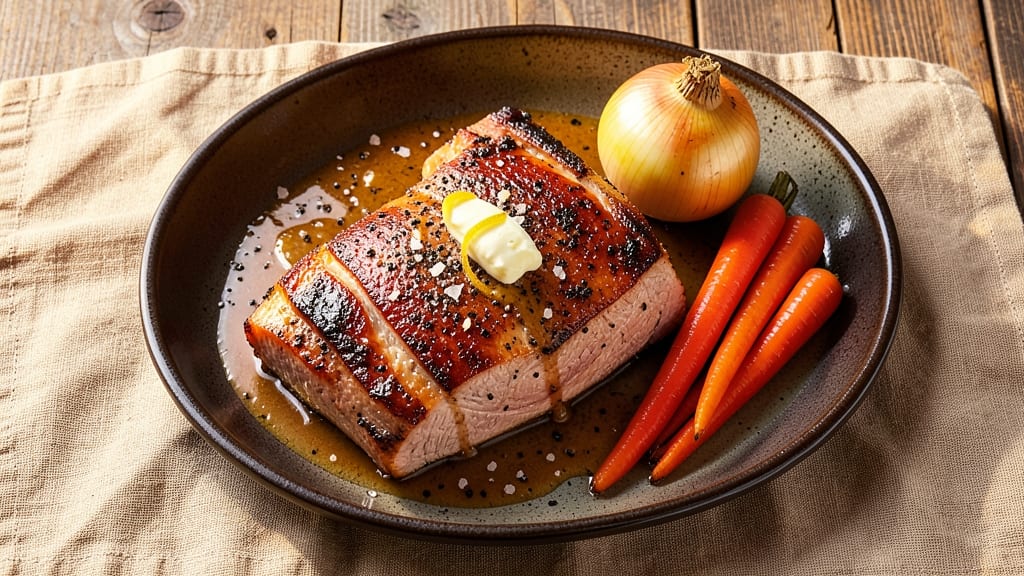
This Berkshire pork loin roast transforms tough cuts into melt-in-your-mouth perfection through slow braising—exactly the technique I mastered while perfecting my weekly 2,000-pound pork runs at The Smoky Pig. The secret lies in dry-brining overnight and controlling moisture through precise temperature shifts, ensuring every bite achieves that legendary shatterproof tenderness.
What makes this recipe different is the balance between traditional braising methods and modern precision timing that keeps the meat juicy while developing deep, caramelized crusts.
The process begins with a 24-hour dry brine using only salt and pepper, which penetrates deeply to enhance natural flavors while preventing moisture loss during cooking. We then slow-roast the pork at 275°F for 3 hours before finishing with a high-heat sear to create that coveted crust.
This method delivers restaurant-quality results without requiring specialized equipment—just patience and attention to temperature control. The result is pork so tender it practically falls apart at the touch, with a rich, savory depth that comes from hours of gentle cooking.
What you'll end up with is a showstopping centerpiece that pairs beautifully with classic sides like apple compote, roasted root vegetables, or a red wine reduction glaze. The meat maintains its natural juices while developing complex flavors from the slow cooking process.
This isn't just another pork roast—it's the kind of dish that makes you want to slow down dinner and savor each bite, exactly as we do at The Smoky Pig when we serve our house-cut heritage pork.
Perfect for holiday gatherings, family dinners, or special occasions when you want to impress without stressing. The recipe scales beautifully for crowds while maintaining perfect tenderness throughout. Let's get started with the complete step-by-step method that's earned me eight BBQ championships and countless thank-you notes from grateful diners.
Ingredients for berkshire pork loin roast
Six pounds of Berkshire pork transforms with just these 15 ingredients—simple yet showstopping.
| Ingredient | Amount | Notes |
|---|---|---|
| Berkshire Pork Loin Roast 🐖 | 4 lb | Bone-in, center-cut preferred |
| Diamond Crystal Kosher Salt 🧂 | 2 tbsp | Coarse grain for dry brine |
| Freshly Ground Black Pepper 🌶️ | 1 tbsp | Cracked peppercorns preferred |
| Unsalted Butter 🧈 | ½ cup | Cold, cubed for searing |
| Yellow Onion 🧅 | 1 whole | Peeled, quartered for braising |
| Carrots 🥕 | 4 whole | Peeled, cut into 2-inch chunks |
| Celery Stalks 🌿 | 3 whole | Trimmed, cut into 2-inch pieces |
| Fresh Thyme Sprigs 🌿 | 4 whole | Stems intact for aroma |
| Fresh Rosemary Sprigs 🌿 | 2 whole | Woody stems for depth |
| Garlic Cloves 🧄 | 6 cloves | Smashed, skins on for flavor |
| Dry Red Wine 🍷 | 1 cup | Bold Cabernet Sauvignon preferred |
| Chicken or Vegetable Stock 🍲 | 2 cups | Homemade or high-quality store-bought |
| Apple Cider Vinegar 🍎 | 1 tbsp | For bright acidity balance |
| Honey 🍯 | 1 tbsp | Wildflower preferred for complexity |
| Bay Leaves 🌿 | 2 whole | Dried, standard size |
The Berkshire pork loin is the star, and local butchers or specialty meat counters are your best bet for quality. Look for cuts with visible marbling and a deep pink hue—The Smoky Pig's preferred suppliers are Heritage Foods or local farms that raise heritage breeds. If you can't find Berkshire, Duroc or Hampshire pork will work in a pinch, though the flavor won't be identical. The dry brine is non-negotiable: Diamond Crystal kosher salt (it dissolves slower, penetrating deeper) and freshly cracked peppercorns elevate the natural richness of the meat. For the herbs, fresh is essential—dried loses its aromatic punch when rehydrated.
No red wine? Substitute with beef stock plus a splash of balsamic vinegar, though the depth of flavor won't be the same. Running short on carrots or celery? Swap for parsnips or fennel, but keep the total volume equal. The honey and vinegar balance is crucial—skip the honey if you prefer a savory-only profile, but the vinegar keeps the dish from becoming too heavy. For the stock, homemade is ideal, but Pacific Foods or Kettle & Fire brands are reliable store-bought options. The butter should be cold and cubed when searing—don't let it melt in your hands, or you'll lose that golden crust.
The dry-brined pork keeps 3-4 days in the fridge, wrapped tightly in parchment. For long-term storage, freeze the uncooked roast for up to 6 months—thaw overnight in the fridge before cooking. The braising liquid can be reheated for up to 5 days, making it perfect for leftovers or quick weeknight dinners. I always make a double batch of the braising liquid—it's fantastic over polenta or mashed potatoes the next day. Store leftovers in an airtight container, and reheat gently on the stove with a splash of water to restore moisture.
Why You'll Love This Recipe
- I swear by this: just salt, pepper, and butter. No fancy rubs or marinades—just that rich Berkshire pork melting in its own fat, with onions caramelizing into sweet, buttery bits. It’s the kind of dish where the simplicity feels like a reward.
- I’ll be real: this takes longer than 30 minutes, but it’s the kind of hands-off cooking that lets me sip wine while the oven does the work. Plus, the aroma wakes up the whole house—so by the time it’s done, everyone’s already hungry. Worth the wait.
Step-by-step instructions for slow-braised Berkshire pork loin roast
Transform that rich Berkshire pork into melt-in-your-mouth perfection with this foolproof braising method.
Dry Brine the Pork for Maximum Flavor and Tenderness
Pat the 4 lb Berkshire Pork Loin Roast completely dry with paper towels—this is critical for developing that coveted crust later. In a small bowl, mix the 2 tbsp Diamond Crystal Kosher Salt and 1 tbsp Freshly Ground Black Pepper until evenly distributed. Rub this generously all over the pork, pressing the seasoning into every crevice, including the cavity if your cut has one.
Place the seasoned pork on a wire rack set over a baking sheet and refrigerate uncovered for at least 12 hours (overnight works best). This dry brine process ensures the salt penetrates deeply, creating a flavorful crust while keeping the meat juicy. The pork should feel noticeably lighter after brining—this confirms proper moisture evaporation.
Sear the Pork for Deep Flavor Foundation
Remove the pork from the refrigerator 1 hour before cooking to bring it to room temperature. In a large Dutch oven, melt the 0.5 cup Unsalted Butter over medium-high heat until it foams. Place the pork in the pot, fat-side down, and sear for 8-10 minutes until a deep golden-brown crust forms. Flip the pork and sear the other side for another 6-8 minutes. This high-heat step develops the Maillard reaction, creating complex flavors that will infuse the braising liquid.
Once browned, remove the pork and set it aside. The butter should have rendered down to about 2 tablespoons in the pot—this golden residue is pure flavor. Don't wipe out the pot; those browned bits will form the base of your braising liquid.
Build the Braising Liquor with Aromatics and Wine
In the same Dutch oven, add the 1 whole Yellow Onion (quartered), 4 whole Carrots (cut into 2-inch chunks), 3 whole Celery Stalks (cut into 2-inch pieces), 4 whole Fresh Thyme Sprigs, 2 whole Fresh Rosemary Sprigs, and 6 cloves Garlic Cloves (smashed). Cook over medium heat for 5 minutes, stirring occasionally, until the vegetables begin to soften. Add the 1 cup Dry Red Wine and scrape up all those flavorful browned bits from the bottom of the pot.
Bring the mixture to a simmer, then reduce heat to low and let it cook for 10 minutes until the liquid reduces by about half. This step develops the base flavors and removes excess alcohol from the wine. The vegetables should be just beginning to caramelize—this adds sweetness that balances the acidity in later steps.
Braise Until Fork-Tender Perfection
Return the seared pork to the Dutch oven along with the 2 cups Chicken or Vegetable Stock, 1 tbsp Apple Cider Vinegar, 1 tbsp Honey, and 2 whole Bay Leaves. Bring the liquid to a gentle simmer, then cover the pot tightly with a lid. Transfer to a 325°F oven and braise for 3-3.5 hours, or until the pork reaches an internal temperature of 203°F and a fork slides in effortlessly.
Here's the thing—don't peek or lift the lid during cooking. Every time you do, you release steam and add 15-20 minutes to your cooking time. The pork is done when it's fork-tender and the braising liquid has reduced to a rich, glossy sauce that coats the vegetables. If the liquid reduces too much before the pork is done, add ½ cup hot water to maintain moisture.
Rest and Serve with Braising Sauce
Remove the pork from the oven and transfer it to a cutting board. Tent loosely with foil and let it rest for 20-30 minutes before carving. This resting period allows the juices to redistribute throughout the meat, ensuring each slice is moist and flavorful. During this time, skim any excess fat from the braising liquid and strain the sauce if you prefer a smoother texture.
Slice the pork against the grain into ½-inch thick slices. Serve immediately with the braising sauce ladled over the top and alongside the caramelized vegetables. Each bite should deliver tender, melt-in-your-mouth pork with rich, complex flavors from the braising process. The sauce should be velvety with just the right balance of sweetness from the honey and acidity from the vinegar, perfectly complementing the pork's natural richness.
Pro Tips For Making Berkshire Pork Loin Roast
- CRANK THE OVEN HIGH: Start your roast in a screaming-hot oven (475°F) for the first 10 minutes—yes, even with Berkshire’s rich fat. I learned this the hard way after a limp roast from lukewarm starts; the initial blast renders fat fast and locks in juices. Just don’t walk away; check it at 8 minutes or risk burning the crust before the center warms.
- SALT THE MEAT TWICE: Coat the roast with kosher salt before searing, then again after roasting—once right after removing it from the oven while it’s still hot. The first layer seasons deep, the second builds that golden crust. (Skip this, and you’ll end up with a bland exterior, no matter how much butter you slather.)
- USE COLD BUTTER: Pat the roast dry, then rub it with cold unsalted butter (cut from the fridge, not softened) mixed with black pepper. Cold butter clings better and melts slowly, basting the meat as it roasts. I used to use room-temp butter—it just slid off, leaving half the flavor behind.
- REST IT UNDER FOIL: Pull the roast at 140°F (it’ll hit 145°F while resting) and tent it loosely with foil for 10 minutes. The residual heat finishes cooking while trapping steam—no dry, stringy slices. (Yes, it’ll feel counterintuitive, but your knife will thank you.)
Creative variations of this recipe
Southern BBQ-Style
Transform this dish into a true Southeast BBQ showstopper by adding ½ cup Carolina Gold mustard and ¼ cup apple cider vinegar to the braising liquid. After the initial sear, wrap the pork in hickory-smoked bacon (about 8 slices) secured with butcher's twine.
Braise as directed, then finish with a 225°F smoker session for 1 hour using hickory or pecan wood. The result? A smoky, tangy crust that'll remind you of my time competing on the BBQ circuit. 🔥
Herb-Crusted French
For a refined take, coat the dry-brined pork in a paste of 2 tbsp Dijon mustard, 1 tbsp chopped fresh tarragon, 1 tbsp chopped chives, and 1 tsp grated lemon zest before searing.
After braising, finish with a béchamel sauce made with 1 cup heavy cream, 2 tbsp butter, and 2 tbsp grated Gruyère cheese. This method won me over during my apprenticeship in Charleston—elegant yet approachable. ✨
Spicy Asian Fusion
Infuse the braising liquid with 1 tbsp gochujang paste, 1 tbsp grated fresh ginger, and 2 tbsp soy sauce instead of the red wine. Add 1 head of garlic smashed with 1-inch slices of galangal (or extra ginger) to the aromatics.
Serve with steamed jasmine rice and a drizzle of sriracha-honey glaze made by simmering 2 tbsp honey with 1 tbsp sriracha for 5 minutes. This fusion version became a hit at The Smoky Pig's Asian BBQ nights. 🌶️
Winter Root Vegetable
Swap the carrots and celery for 1 lb parsnips (cut into chunks), 1 lb sweet potatoes (peeled and cubed), and 2 large turnips (quartered). Add 1 cinnamon stick and 2 star anise pods to the braising liquid for warmth.
This hearty variation makes an incredible holiday centerpiece—perfect for when my family gathers at our farm in Georgia. The vegetables become caramelized and sweet, balancing the rich pork beautifully. 🍠
Quick Weeknight Adaptation
For a faster version, use the same dry brine but reduce braising time to 2 hours at 350°F in a slow cooker on high. Add 1 packet onion soup mix to the braising liquid for convenience without sacrificing flavor.
This method works perfectly for my busy weeknights when I need to feed the crew after a long shift at the restaurant. The pork stays tender, though slightly less fall-apart than the full braise. 💡
Nutrition facts
Frequently asked questions
Why is dry-brining the pork overnight so important?
The 24-hour dry brine creates a perfect balance of seasoning and moisture control. The salt penetrates deeply, enhancing natural flavors while preventing moisture loss during cooking. This method also develops that coveted crust that locks in juices, giving you restaurant-quality tenderness. Skipping it can result in dry, flavorless meat.
Can I use a different cut of pork instead of Berkshire?
While Berkshire delivers the best marbling and flavor, you can use Duroc or Hampshire pork in a pinch. For similar results, choose a bone-in loin with good fat coverage. The braising method works well, but the texture and richness won't be identical. Local butchers can help identify quality cuts with visible marbling.
What's the best way to check if the pork is done?
Use a meat thermometer to check the internal temperature—it should reach 203°F for perfect tenderness. The pork should also be fork-tender, with juices running clear when pierced. If the braising liquid reduces too quickly, add ½ cup hot water to maintain moisture without overcooking.
How do I store leftovers?
Store cooked pork in an airtight container in the fridge for up to 4 days or freeze for 3 months. Reheat gently on the stove with a splash of water to restore moisture. The braising sauce reheats well too—perfect for quick weeknight meals! The pork will be even more tender after resting overnight.
What's the secret to that perfect crust?
The crust comes from two key steps: searing the pork until deep golden-brown before braising, and using cold butter that renders slowly. Don't rush the sear—it needs 8-10 minutes per side to develop the Maillard reaction. The butter's rendered fat also creates a flavorful base for the braising liquid.